
Treatment access
Patients reaching treatment per 100 strongest TMS candidates identified
Production deployment
Before OutcomesAI
65
per 100
With OutcomesAI live
88
per 100
+23
additional patients treated per 100 strongest candidates
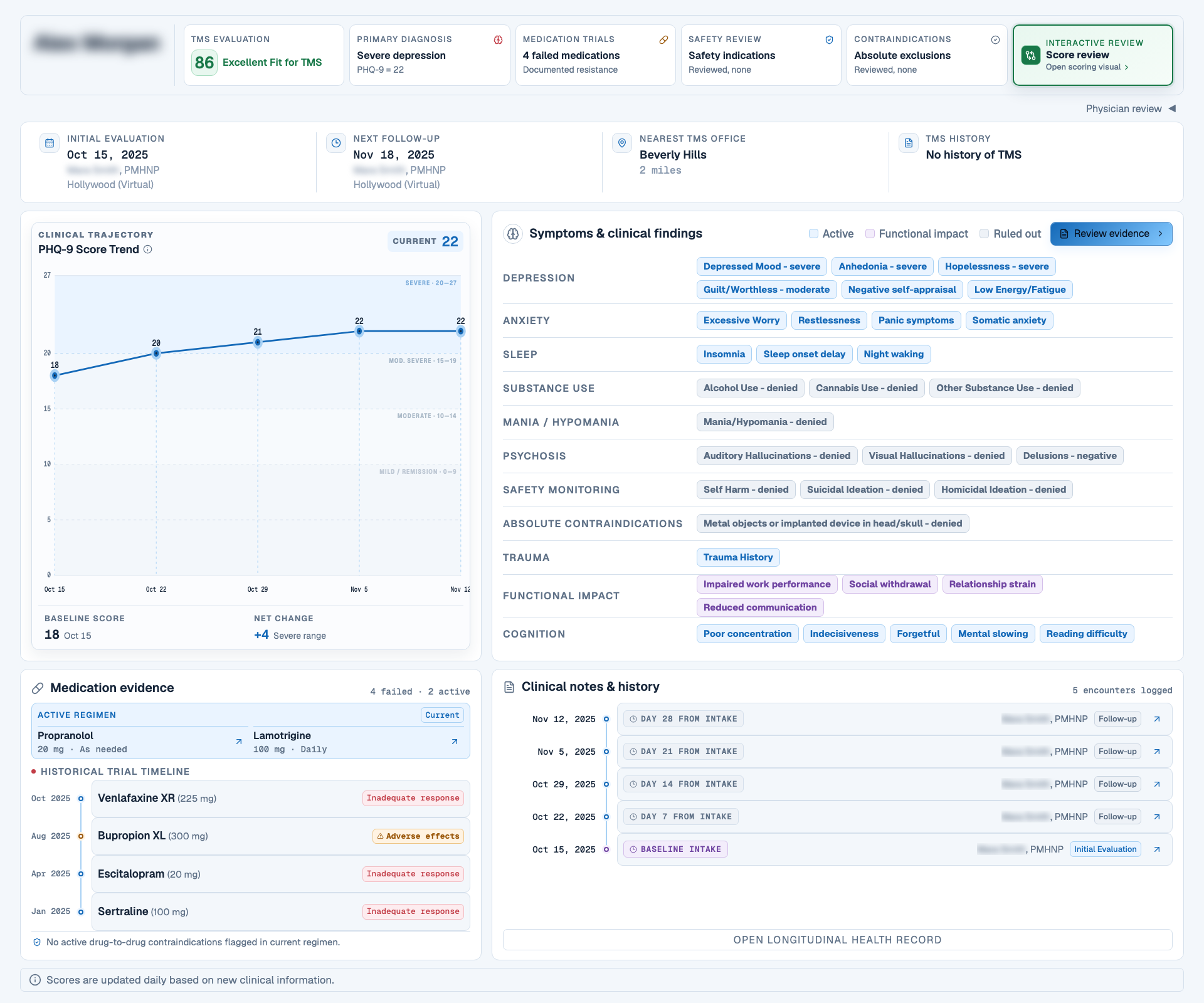
OutcomesAI turns fragmented clinical information into traceable evidence, evaluates it against physician-defined criteria, and connects treatment opportunities to clinical workflows.
AI structures the evidence. Physicians define the criteria. Clinicians decide.
Production Impact
OutcomesAI’s first production deployment in interventional psychiatry shows Clinical Opportunity Intelligence operating at clinical scale, with measured changes in treatment conversion and time to care among the strongest TMS candidates.
Explore the ImpactTreatment access
Production deployment
Before OutcomesAI
65
per 100
With OutcomesAI live
88
per 100
+23
additional patients treated per 100 strongest candidates
Speed to care
10days
H2 2024
5days
Q1 2026
Most patients in the strongest-candidate tier reached treatment within 30 days.
Deployment scale
Evidence validation
The Intelligence Layer
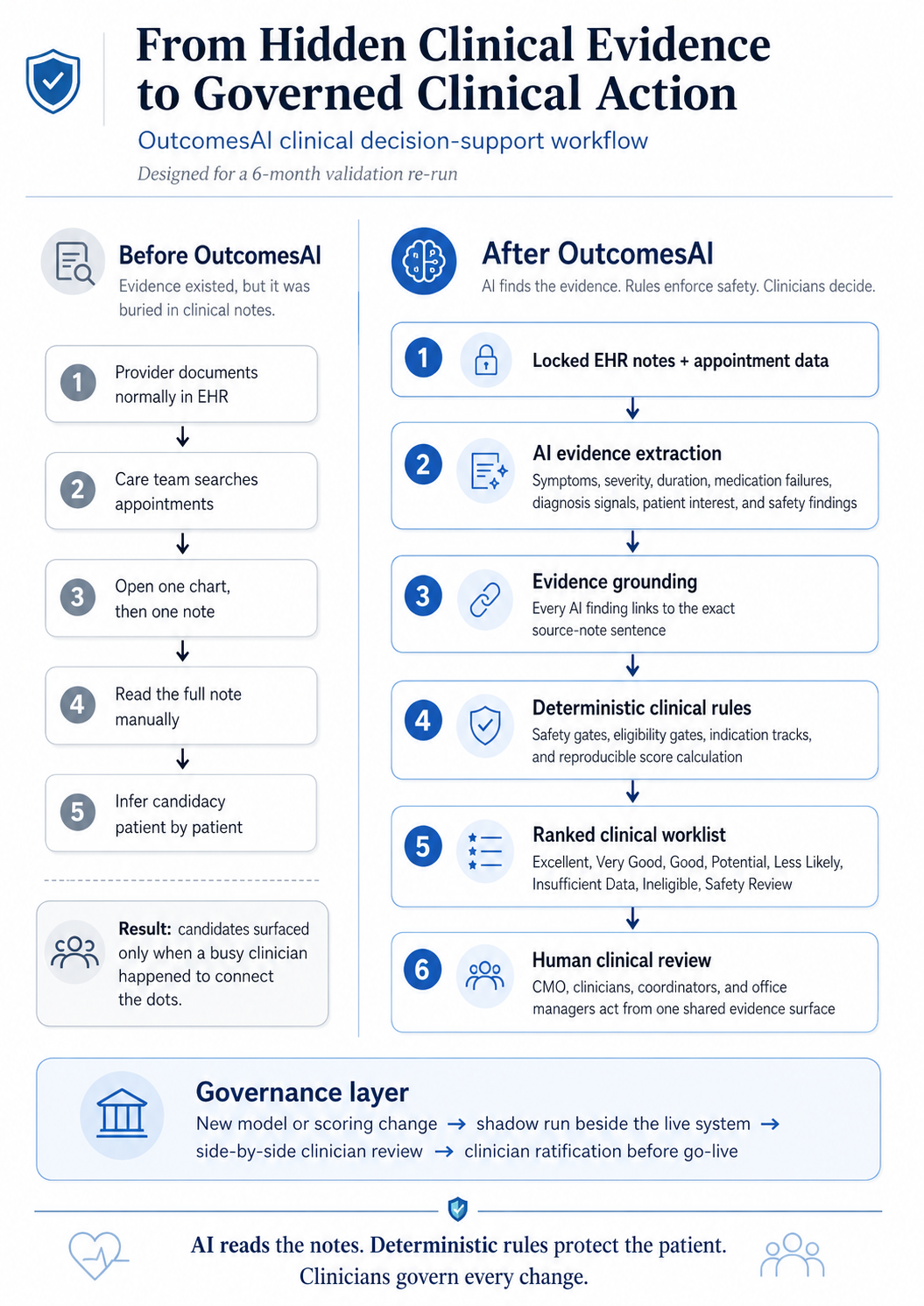
Healthcare organizations already hold much of the evidence needed to identify treatment opportunities. OutcomesAI structures that evidence, evaluates it against physician-defined criteria, and connects qualified opportunities to the teams responsible for care.
OutcomesAI serves as the intelligence layer between existing clinical evidence and action.
Existing clinical evidence
The electronic health record remains the source of truth. OutcomesAI works alongside the record rather than replacing it.
Source systems remain authoritative.
OutcomesAI
Intelligence layer
Structure
AI structures clinical evidence
Identify, extract, classify, and structure clinical evidence.
Evaluate
Physician-defined criteria
Apply physician-defined deterministic scoring, qualification, and safety criteria.
Identify
Treatment opportunity
Produce a transparent opportunity with the evidence needed for clinician review.
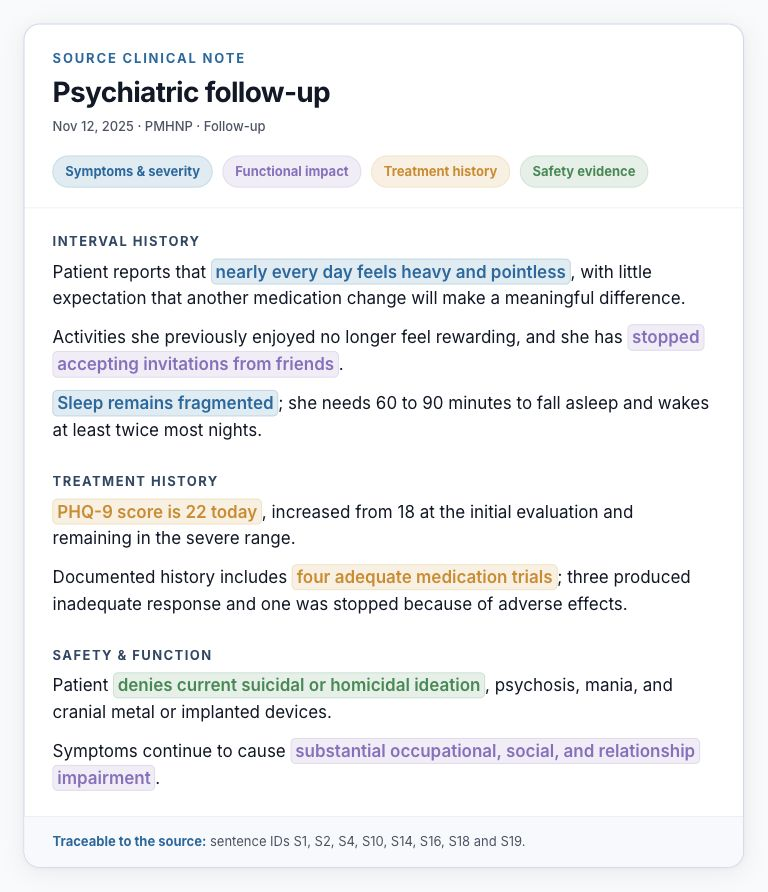
Every finding remains traceable.
Linked to supporting source documentation
Clinical action
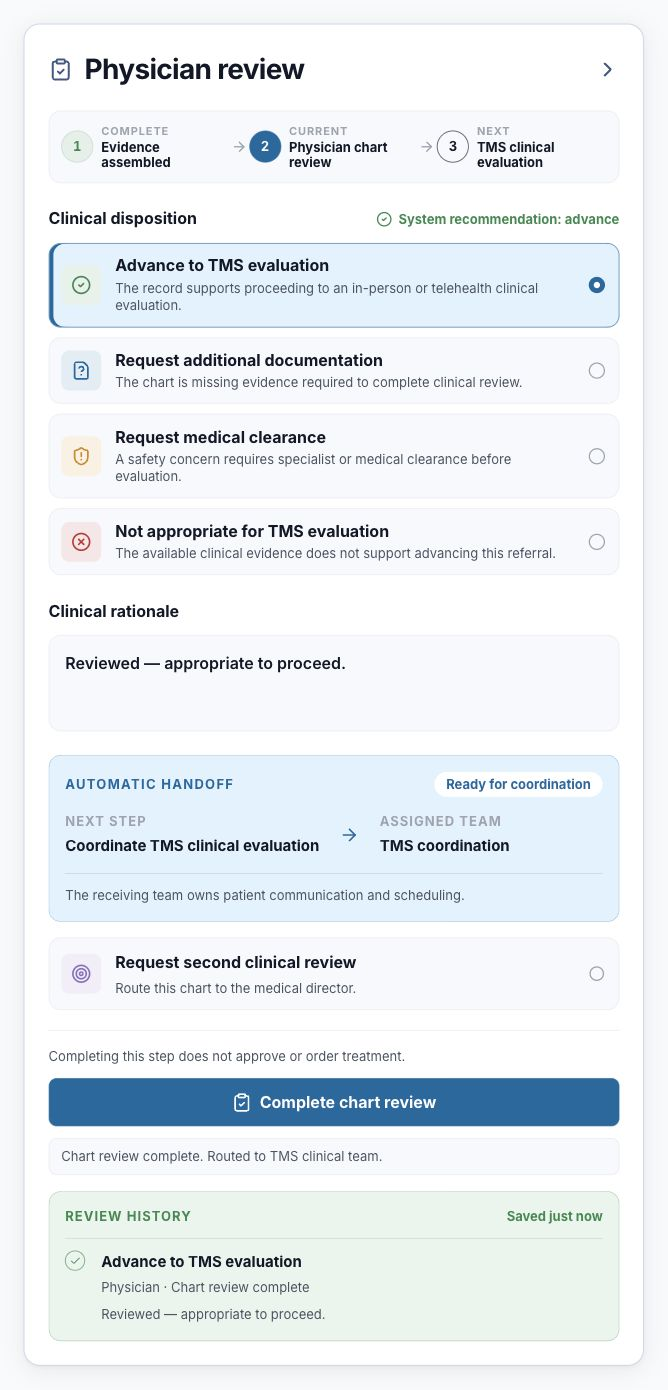
Clinician review remains the decision point.
Care teams coordinate the appropriate next step. Treatment orders and approvals remain with the care team.
First production application
TMS candidate identification for treatment-resistant depression
Broader platform architecture
When treatment eligibility depends on evidence distributed across the longitudinal record, the same intelligence layer can help identify opportunities across specialties, interventions, and patient populations.
OutcomesAI in Action
Watch how OutcomesAI connects fragmented clinical information, creates traceable evidence, applies governed clinical logic, and routes treatment opportunities into the care workflow while keeping physicians in control.
3-minute platform overview · Includes audio
Request a Demo →Responsible AI
OutcomesAI keeps the evidence, clinical logic, and decision authority visible so care teams can understand how an opportunity reached review.
Traceable
Every finding remains connected to supporting clinical documentation.
Governed
Physician-defined rules and explicit safety controls remain separate from AI evidence extraction.
Human-led
Clinicians retain authority over treatment decisions and patient care.
Clinical Proof
OutcomesAI first applied its evidence extraction, deterministic rules, safety controls, and clinician review workflow to identify appropriate TMS opportunities from psychiatric documentation.
TMS validates the platform’s clinical method; it does not define the limits of the platform. The same governed architecture can support additional care pathways with pathway-specific evidence and criteria.
Security & Governance
OutcomesAI protects patient data, constrains AI to evidence extraction, keeps deterministic safety controls reviewable, and preserves an auditable connection between each finding and its source.
Explore security and governance →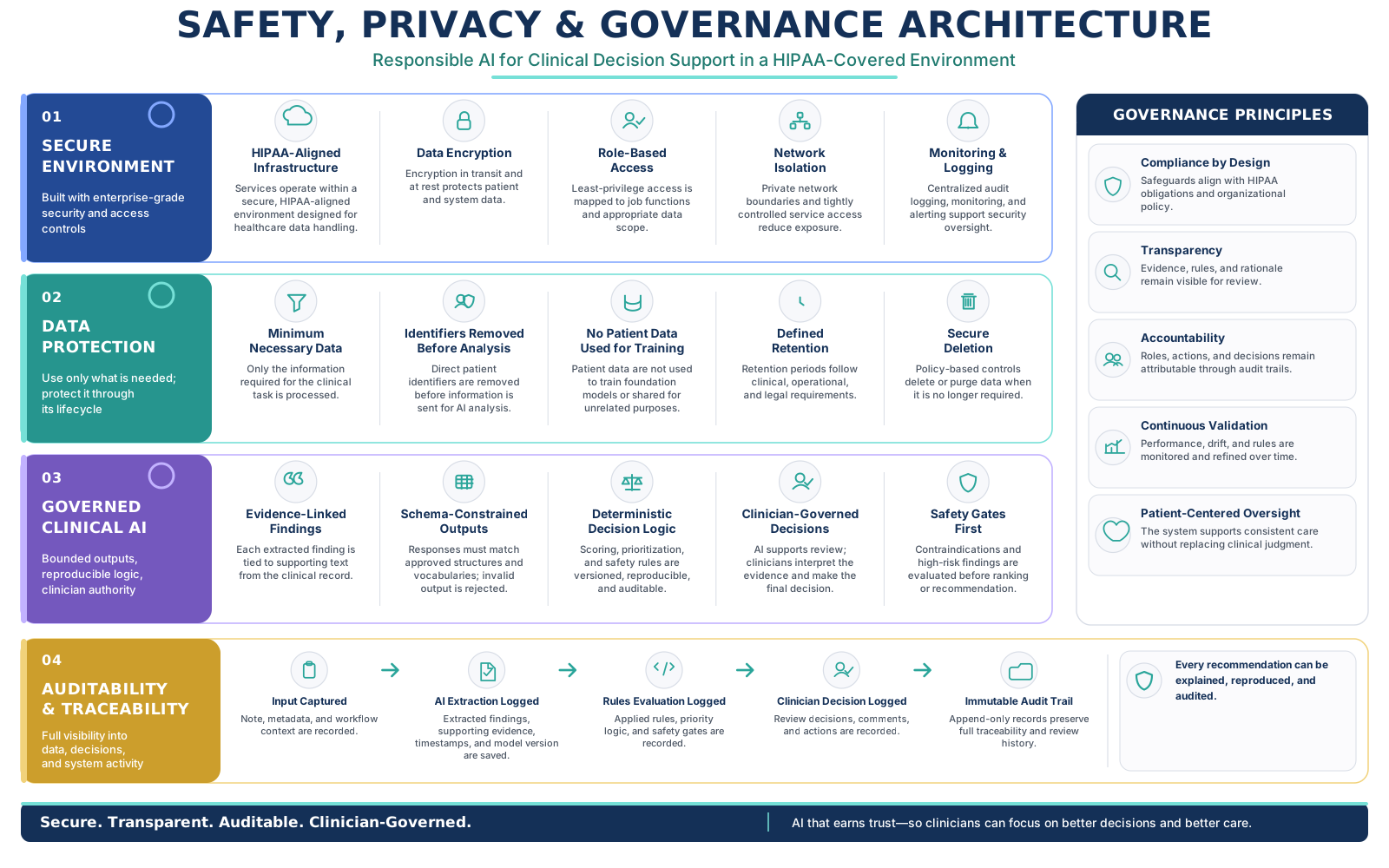
Explore how OutcomesAI can turn the clinical documentation you already have into transparent, evidence-backed treatment opportunities.