Identifying Patients Who May Benefit
From TMS
The initial application of OutcomesAI Clinical Opportunity Intelligence uses AI to extract evidence from psychiatric notes, deterministic rules to evaluate clinical and safety criteria, and clinicians to make every care decision.
More than 6,000
new-patient evaluations a year across 12 offices
65 → 88
of every 100 strongest TMS candidates reached treatment
+23
more patients per 100
Most
reached treatment within 30 days
10 → 7 days
strongest-tier median wait
54 → 23 days
slowest tenth of strongest candidates
51 → 28 days
third-tier wait
OutcomesAI supports identification of documented treatment opportunities and helps clinical teams prioritize which records warrant review.
← Back to the Clinical Intelligence overviewWhy TMS Was Selected First
A clinically important pathway with evidence that is documented—but difficult to find at scale.
TMS provided an evidence-rich first application because candidacy depends on information distributed across psychiatric documentation, safety criteria must remain explicit, and clinicians need transparent support for review.
Evidence-rich documentation
Symptoms, medication trials, response history, functional impact, and patient interest are already present in psychiatric notes.
Manual review does not scale
Finding appropriate patients otherwise requires opening evaluations and assembling evidence one chart at a time.
Explicit clinical criteria
Pathway-specific rules and safety checks can be separated from AI extraction, inspected, versioned, and governed.
Clinician-reviewed workflow
The application helps teams prioritize documented opportunities while clinicians retain authority over every next step.
Building a TMS pipeline shouldn’t depend on chance
Severe, medication-resistant depression documented visit after visit. Failed medication trials. Functional decline. The evidence of TMS candidacy sits in your clinical notes—but finding one candidate means opening the chart, clicking into each appointment, and reading every note in full.
Candidates surface only when a busy clinician happens to connect the dots
Manual panel-wide review is impossible with real clinical caseloads
Patients with clear indications are lost before treatment begins
AI extracts evidence. Deterministic rules rank. Clinicians decide.
A neuro-symbolic architecture built for clinical safety: a grounded extractor feeding a deterministic, clinician-tunable scoring engine.
Every eligible note is read
- Connects to locked notes in the production EHR—no documentation changes
- Analyzes every eligible patient automatically, hundreds of notes per month
- Turns a full-panel review problem into a ranked clinical worklist
Findings are coded & evidence-backed
- Every finding is a code from a controlled clinical vocabulary—never free-form narrative
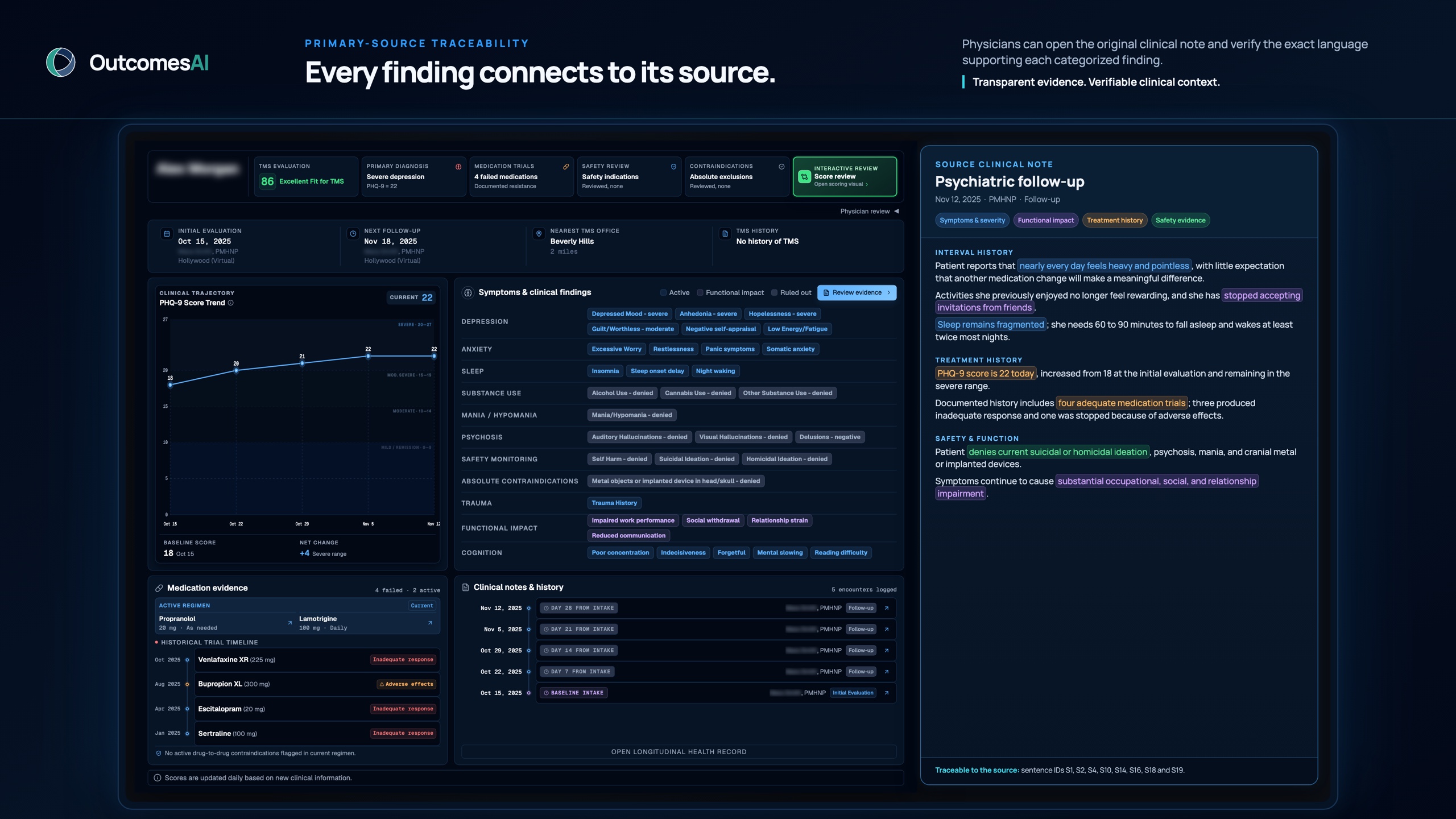
- Every finding is backed by a verbatim quote from the source note
- The system is allowed to say “the note doesn’t say”—it never invents precision
Deterministic scoring ranks candidates
- Scores are reproducible arithmetic over coded findings—versioned, inspectable, clinician-tunable
- Hard contraindications route to mandatory Safety Review—no model output can bypass the gate
- Your team works from one ranked, filterable queue
Clinicians review the opportunity
- The worklist shows the evidence and note excerpts behind each rating
- Reviewers verify context, consider the full patient record, and document their decision
- No outreach or treatment decision is made autonomously
Methodology & Governance
Governed extraction supports clinician review
AI identifies evidence using a controlled clinical vocabulary. Each finding remains connected to the supporting sentence in the note, while deterministic rules evaluate defined clinical and safety criteria.
98.4% valid on the first pass
2,990 records from a six-month period not used to build the vocabulary.
This is a supporting extraction-methodology measure. It is not a patient outcome and does not measure or imply autonomous treatment decisions.
- Every finding opens to the sentence in the note that supports it
- New versions run in shadow beside the live system—activated only after clinician ratification
- Scores and configurations are append-only and versioned—any past decision can be reconstructed exactly
- Payer-blind by principle: insurance coverage never shapes clinical priority
Safety Gates
Hard contraindications structurally route to Safety Review—by architecture, not tuning.
Verbatim Evidence
Every finding cites the exact sentence read in the source note.
Whole-Team Queue
CMO, clinicians, care coordinators, and office managers share one ranked worklist.
Clinician Final Say
Decision support only—the clinician always retains the treatment decision.
Primary-source evidence traceability
 Open full resolution
Review the broader Clinical Intelligence platform or explore security and governance.
See the initial clinical application in context
TMS validates the Clinical Opportunity Intelligence method. The platform is designed to support additional care pathways with pathway-specific evidence, rules, and clinical governance.