From hidden clinical evidence to a clinician-reviewed TMS workflow
A multi-site interventional psychiatry practice used OutcomesAI to turn evidence already documented in psychiatric evaluations into a transparent, clinician-reviewed workflow for identifying patients who may benefit from TMS.
Clinical Transformation
Documentation becomes a structured, reviewable opportunity queue
OutcomesAI supports identification of treatment opportunities documented in psychiatric evaluations. It organizes source-linked evidence into a governed workflow that helps clinical teams prioritize review while preserving clinical judgment.
More than 6,000
new-patient evaluations a year across 12 offices
65 → 88
of every 100 strongest TMS candidates reached treatment
+23
more patients per 100
Most
reached treatment within 30 days
Of every 100 of the practice’s strongest TMS candidates, 65 reached treatment before OutcomesAI. With OutcomesAI live, 88 out of every 100 reached treatment. That is 23 more patients per 100.
10 → 7 days
strongest-tier median wait
54 → 23 days
slowest tenth of strongest candidates
51 → 28 days
third-tier wait
Operational Challenge
Strong candidates were hidden in ordinary documentation
Treatment-resistant depression, failed medication trials, functional decline, contraindications, patient interest, location, and follow-up timing were documented across psychiatric evaluations and EHR data. The information existed, but no team could read every evaluation and assemble it consistently at practice scale.
Workflow Objective
Support consistent identification without disrupting care
The goal was to identify treatment-resistant depression patients who might qualify for TMS but had not yet surfaced, with concise evidence clinicians could verify inside the existing workflow.
Implementation
Evidence extraction became a clinician-controlled workflow
1 · Extract
Read existing evaluations
AI identified treatment history, symptoms, contraindications, interest, and other relevant evidence in unstructured notes.
2 · Structure
Create traceable findings
Each structured finding retained the source evidence clinicians needed to verify it.
3 · Prioritize
Apply deterministic criteria
Versioned rules evaluated the findings and placed potential candidates into a ranked worklist.
4 · Review
Keep clinicians in control
Clinicians reviewed the evidence, safety context, and patient record before deciding whether to act.
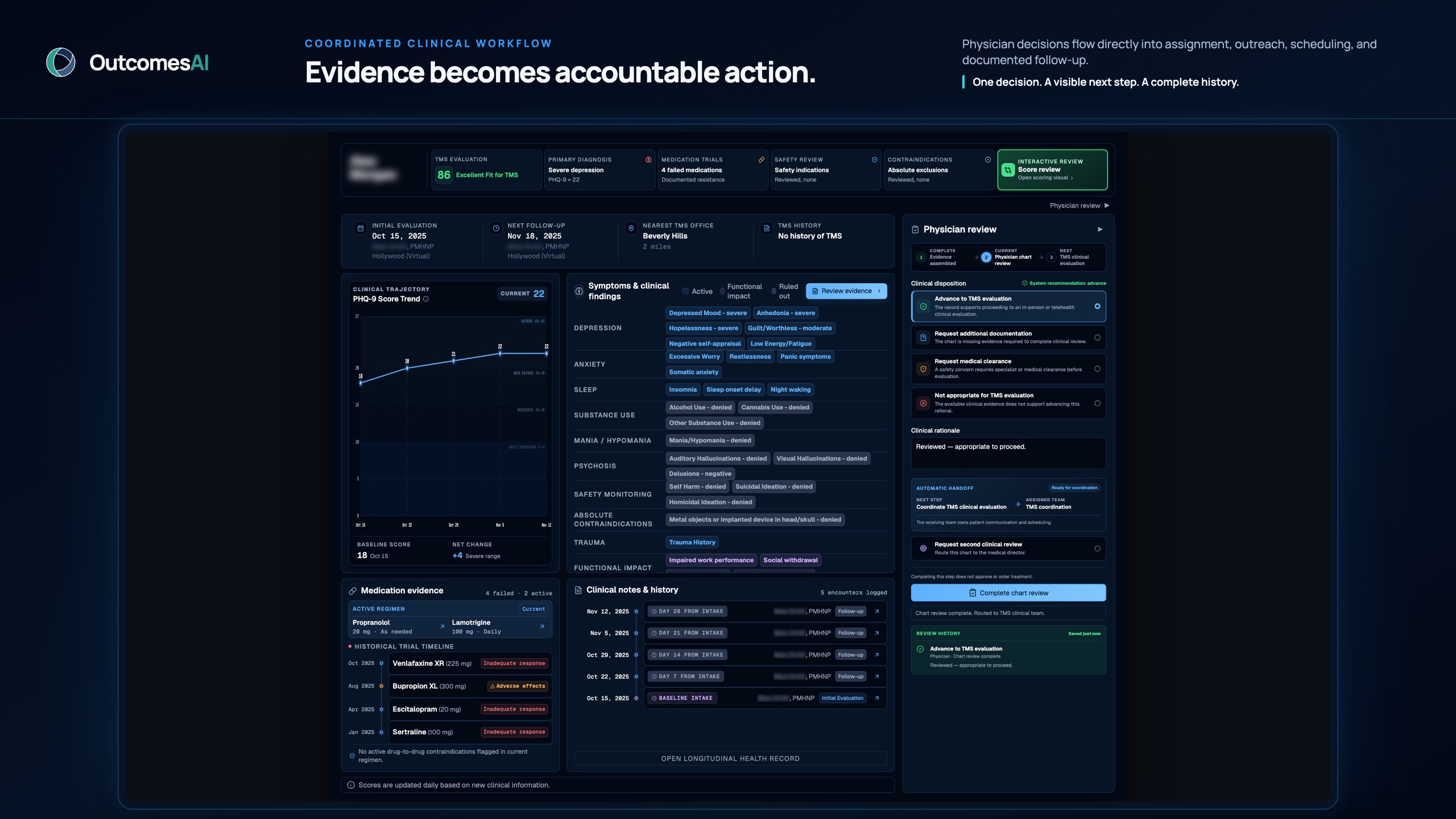 Open full resolution
Before
Opportunity review depended on manual discovery
Teams searched scattered EHR screens and could not consistently review every psychiatric evaluation at practice scale.
With OutcomesAI
A daily queue made evidence reviewable
The same documentation produced a ranked, filterable worklist with source-linked evidence. Clinicians retained every outreach and treatment decision.
Approved Claim Context
How the approved outcomes are stated
Of every 100 of the practice’s strongest TMS candidates, 65 reached treatment before OutcomesAI. With OutcomesAI live, 88 out of every 100 reached treatment. That is 23 more patients per 100.
With OutcomesAI live, 88 out of every 100 reached treatment, most within 30 days.
We tested it on 2,990 records from a six-month period we had not used to build the vocabulary. 98.4% came back valid on the first pass.
Clinical transformation summary
- Clinical evidence becomes reviewable. AI extracts relevant findings from psychiatric documentation and retains the supporting source text.
- Teams can prioritize documented opportunities. A ranked worklist helps clinical teams focus attention on records that warrant review.
- Safety logic stays explicit. Deterministic rules evaluate defined clinical criteria and safety conditions outside the AI model.
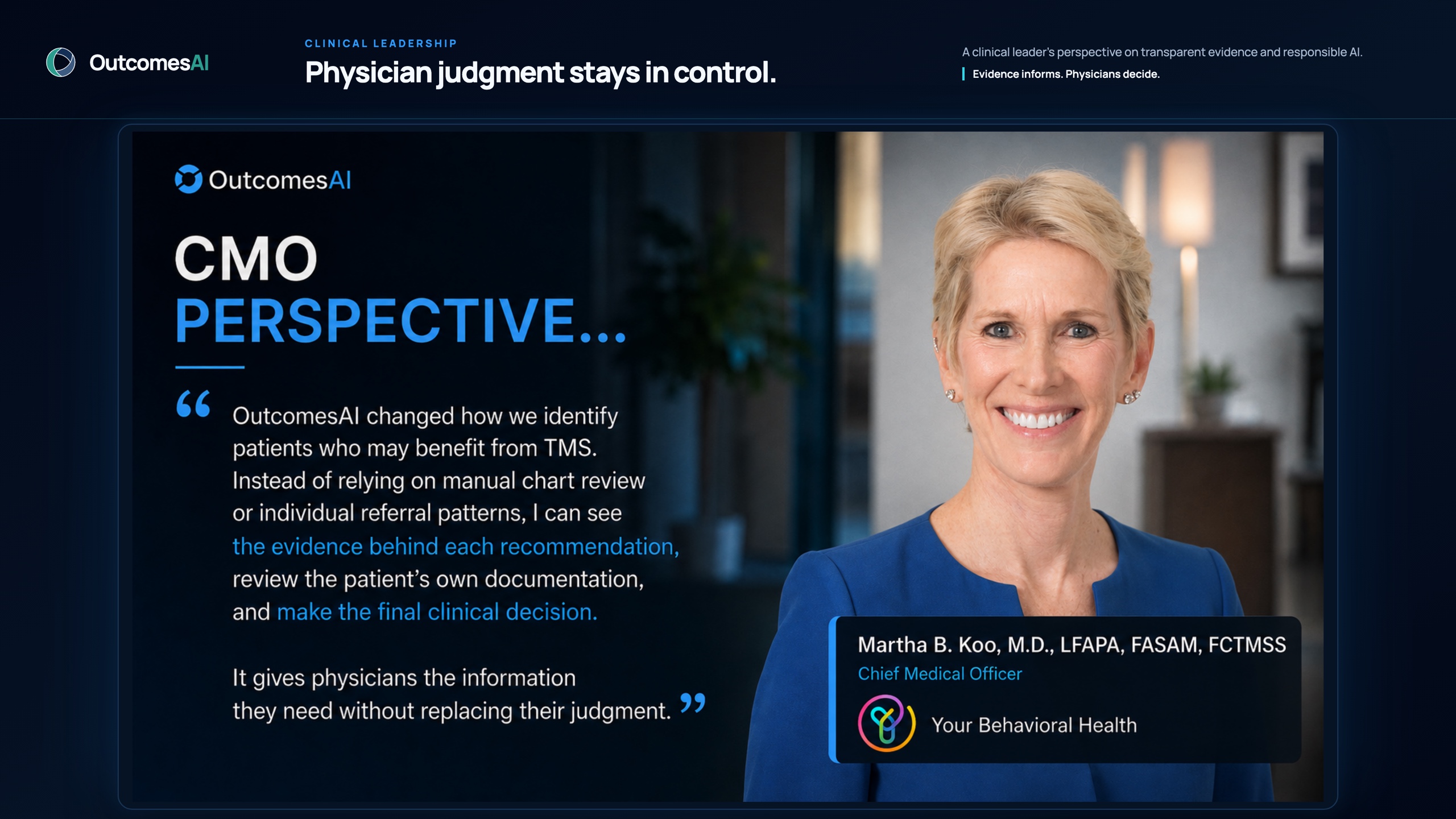
- Care delivery was not disrupted. Providers documented as usual. The EHR remained the source of truth. Clinicians retained the final treatment decision.
 Open full resolution
Why it matters beyond TMS
TMS is the initial clinical application. The broader product is behavioral-health Clinical Intelligence: finding documented care opportunities across specialty pathways such as Spravato/esketamine, ketamine, substance-use, psychotherapy, and PTSD.
Explore the Clinical Intelligence Platform Review the TMS Methodology