Turn unstructured clinical documentation into
evidence-backed treatment opportunities.
OutcomesAI uses AI-powered clinical evidence extraction and transparent decision support to help healthcare teams find appropriate treatment opportunities hidden in clinical notes—while keeping judgment with clinicians.
Unified clinical evidence view
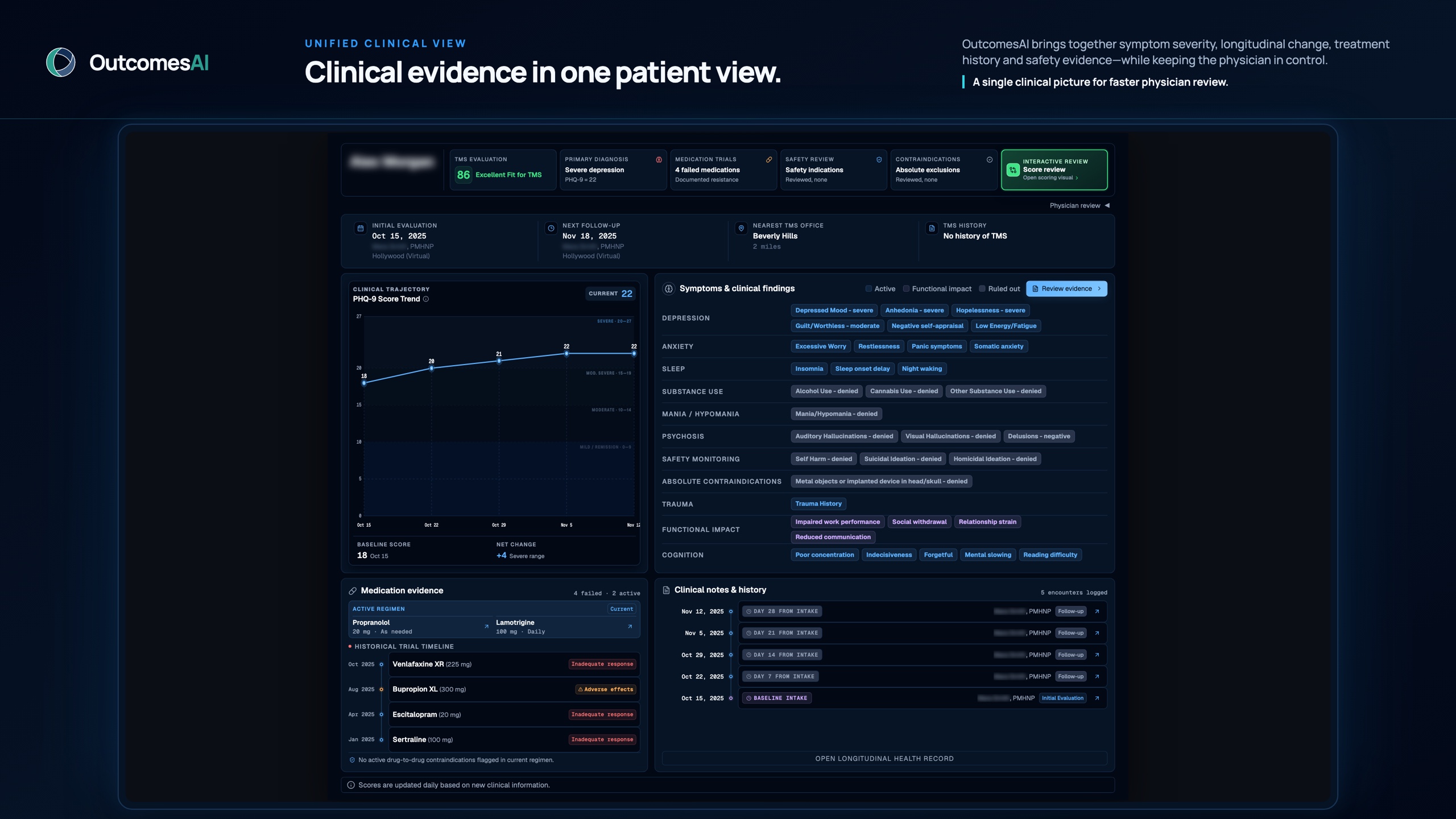 Open full resolution
The Problem
Clinical evidence exists in the documentation — but manual review does not scale.
Critical evidence is buried in narrative notes
The information that matters most lives inside long, unstructured documentation - recorded differently from one clinician to the next.
Reviewing every patient is not realistic
Finding the right patients means opening charts one by one and reading evaluations manually. At real-world volume, that is not sustainable.
The backlog grows faster than the team can clear it
Each chart takes time, focus, and clinical judgment to review - creating a constant bottleneck for already stretched staff.
Identification depends too much on memory and time
Patients are surfaced only if someone recognizes the pattern, remembers what to look for, and has time to act.
Missed opportunities remain invisible
There is no reliable signal when a patient who may benefit from a next step in care is overlooked, delayed, or never surfaced at all.
The problem is not a lack of patients who may benefit.
The problem is a workflow that cannot reliably find them.
Why It Matters
What better identification makes possible.
When clinical evidence is easier to find, care teams can review more appropriate opportunities without asking clinicians to change how they document.
More patients surfaced
Care teams can find documented needs that would otherwise remain buried in notes.
Faster review
Evidence is organized before the clinician opens the chart, reducing manual search.
Better care matching
Patients can be reviewed for the pathway that fits their history, symptoms, risks, and goals.
Lower cognitive burden
Clinicians see relevant evidence, safety considerations, and next-step context in one place.
More consistent follow-through
Teams can track review status, next appointments, routing, and handoffs across locations.
The goal is not to generate more recommendations.
The goal is to make clinically appropriate opportunities easier to see, review, and act on.
Transparent evidence and protected clinical logic
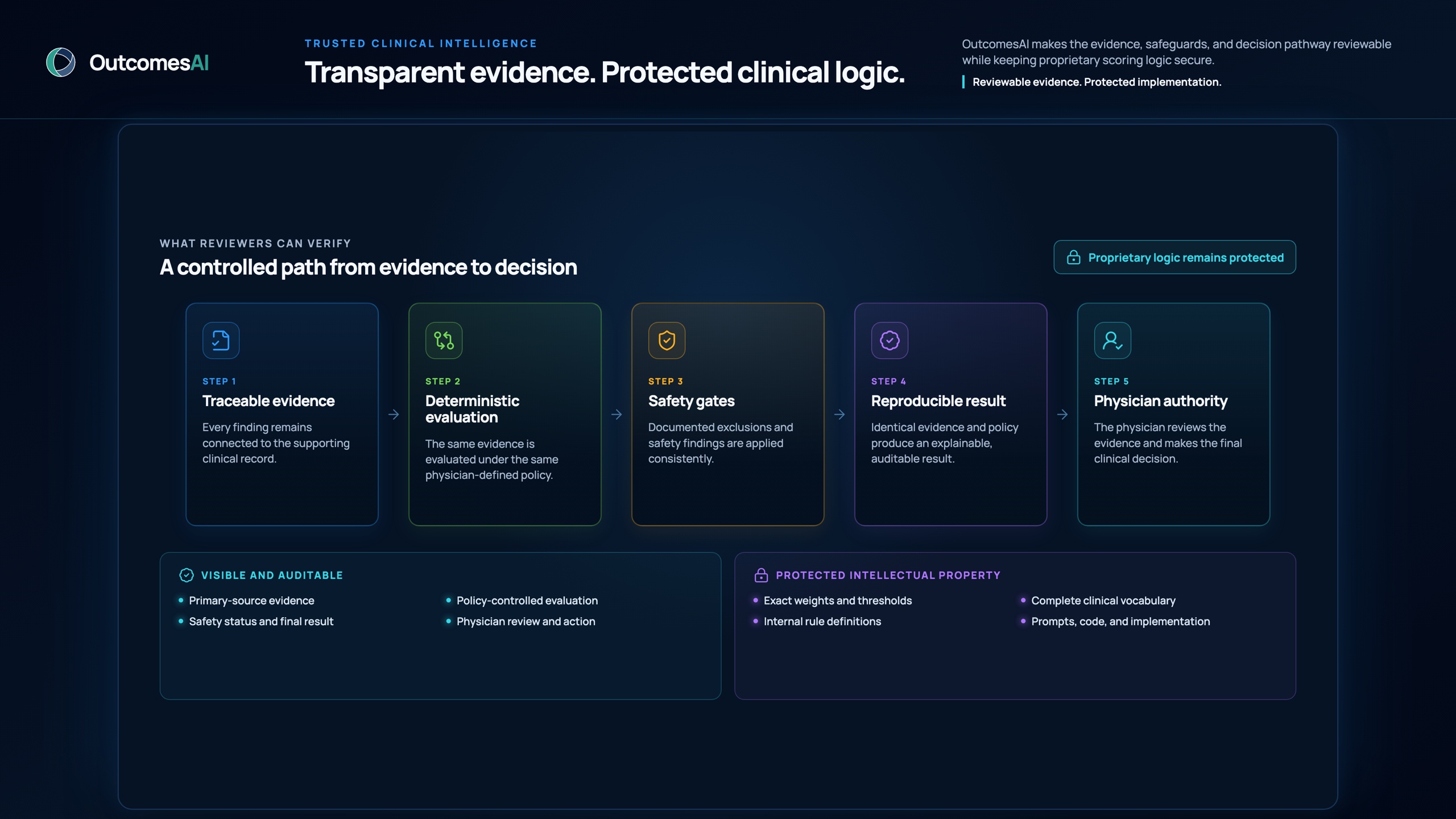 Open full resolution
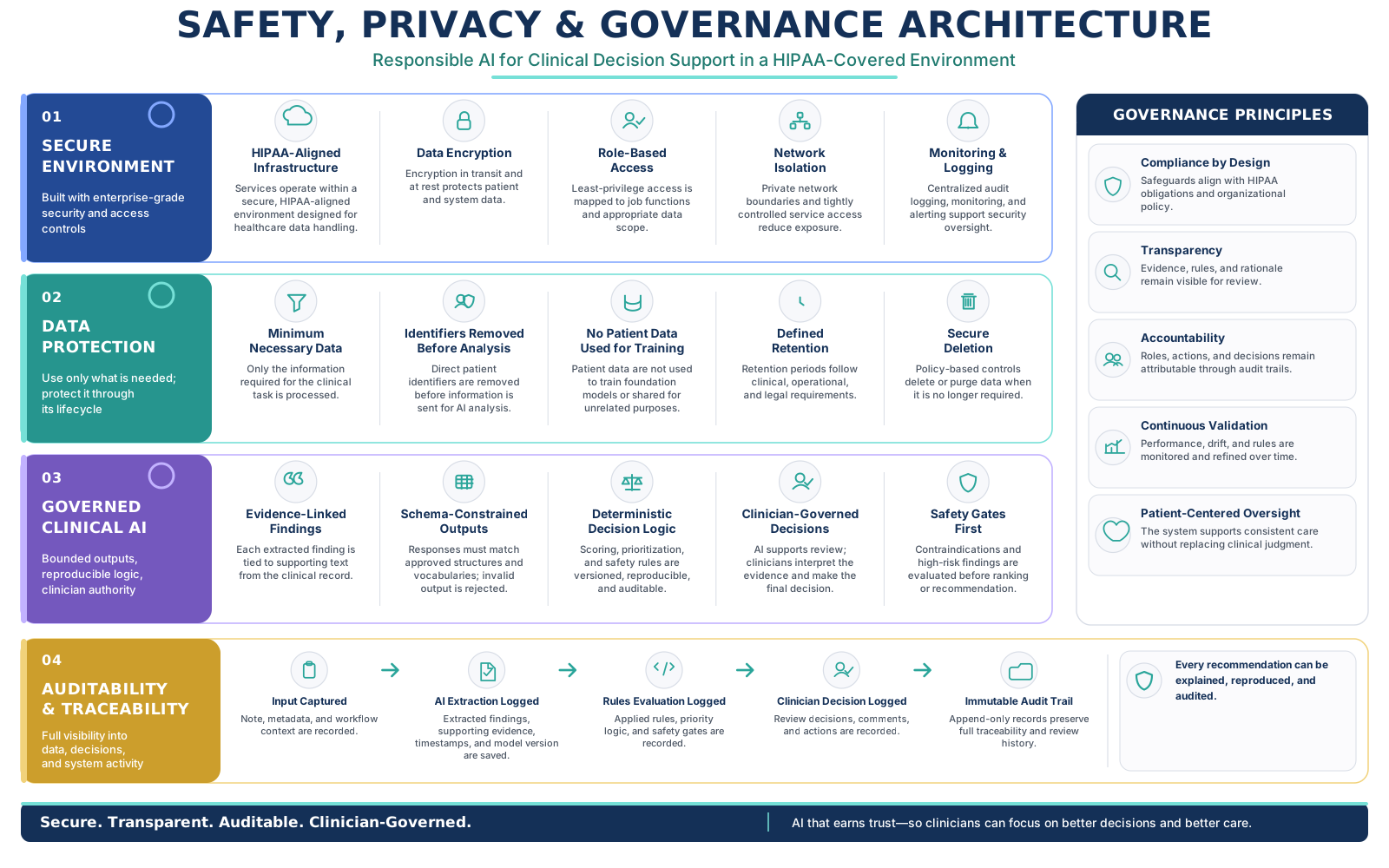
Safety, Privacy & Governance
Built for secure, auditable clinical decision support.
The architecture separates AI evidence extraction from deterministic decision logic, preserves clinician authority, and keeps findings traceable to their supporting documentation.
Designed for Behavioral Health
One architecture, multiple specialty pathways
The platform is built to mine clinical documentation for care opportunities across behavioral health, not just one treatment line.
Initial Clinical Application
TMS
Identifies treatment-resistant depression and OCD candidates from psychiatric evaluations with evidence-backed ranking.
Expandable
Spravato / Esketamine
Surfaces patients whose documented history may warrant clinician review for interventional depression pathways.
Expandable
Ketamine
Supports pathway-specific evidence extraction, contraindication review, and patient prioritization.
Expandable
Psychotherapy & PTSD
Finds documented need, engagement risk, symptom burden, and follow-up opportunities across the patient panel.
Clinical Transformation in Practice
Designed to support consistent, evidence-backed clinical review.
Clinical Opportunity Intelligence helps teams move from manual chart discovery to a structured evidence-review workflow. The platform surfaces relevant documentation, organizes findings, and supports prioritization without replacing professional judgment. TMS is the initial clinical application of this architecture, not the limit of the platform.
Evidence extraction
AI identifies relevant clinical evidence
The model extracts findings from unstructured clinical documentation.
Source traceability
Findings retain supporting evidence
Reviewers can inspect the documentation that supports each structured finding.
Deterministic evaluation
Rules evaluate clinical criteria
Defined clinical logic and safety checks operate separately from AI extraction.
Clinician oversight
Clinicians decide the next step
Care teams review the evidence, consider the full record, and retain authority over care decisions.
More than 6,000
new-patient evaluations a year across 12 offices
65 → 88
of every 100 strongest TMS candidates reached treatment
+23 more patients per 100.
10 → 7 days
strongest-tier median wait
slowest tenth of strongest candidates: 54 → 23 days. third-tier wait: 51 → 28 days.
Most
reached treatment within 30 days
Governed Clinical AI
Built to support professional judgment, not replace it
OutcomesAI is decision support. The system assembles evidence, helps teams prioritize review, and flags safety concerns while preserving clinician control over care decisions.
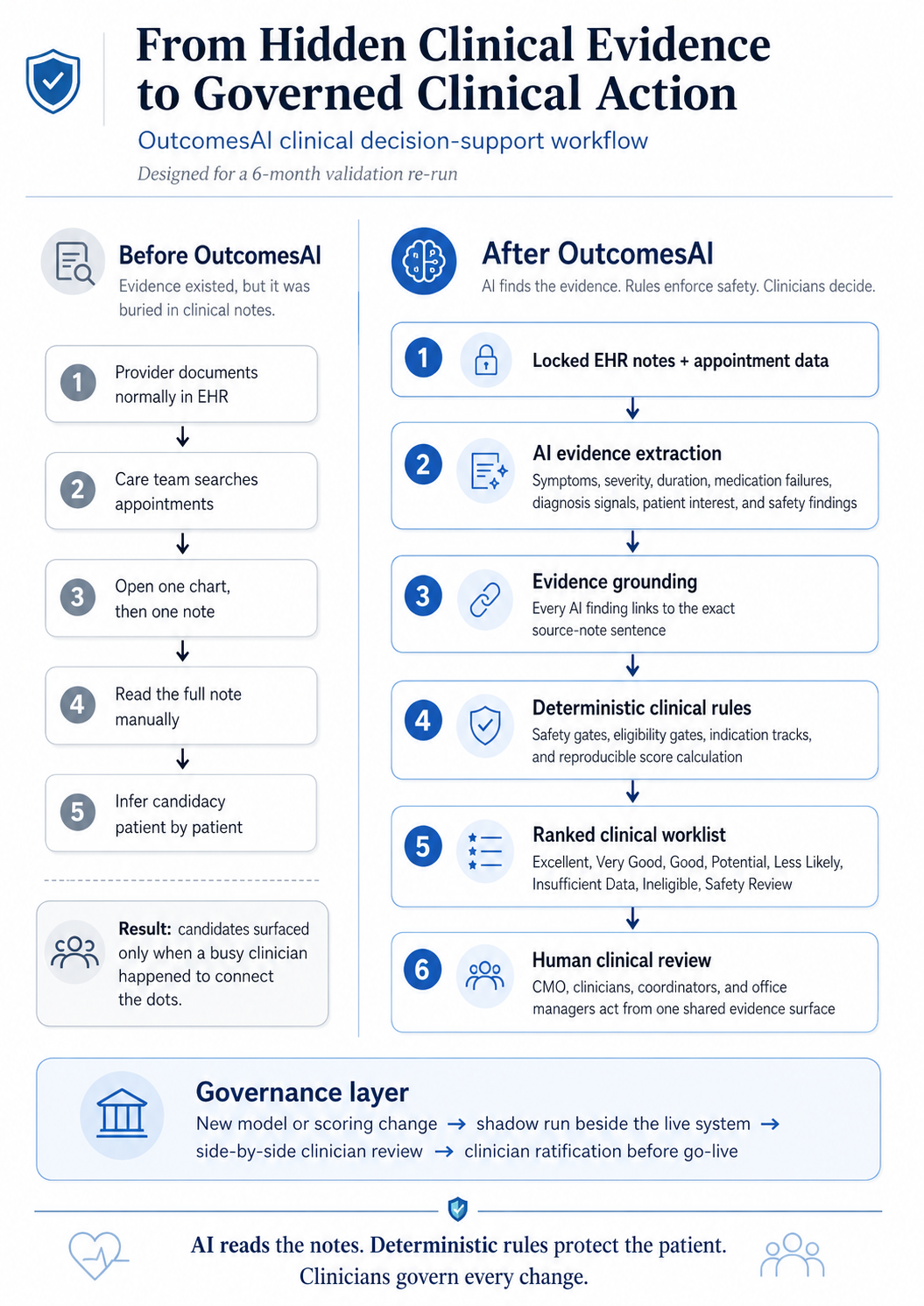
Explore the Evidence Architecture
From product architecture to clinician-reviewed action.
Initial Application
TMS clinical methodology
See how evidence is extracted, candidates are ranked, and clinicians review the worklist.
Explore the TMS application →Clinical Transformation
TMS workflow example
Review how documentation becomes a structured, evidence-linked workflow for clinical review.
Review the clinical application →Governance
Security and clinical governance
Review the controls that support traceability, bounded AI, deterministic rules, and human oversight.
Explore governance →Bring evidence-backed AI to your next care pathway
Start with the documentation you already have. No workflow changes, no new templates, and no real patient data in public demos.