Documentation Volume
Evidence is distributed across notes
Relevant facts appear across evaluations, follow-ups, medication histories, and other unstructured clinical documentation.
OutcomesAI applies AI-powered evidence extraction and transparent clinical decision support to help healthcare organizations identify treatment opportunities hidden within unstructured documentation.
1 · The Challenge
Healthcare organizations generate large volumes of narrative documentation. Those notes contain treatment history, symptoms, response, contraindications, patient interest, and other clinically relevant evidence—but finding and assembling it still depends on manual chart review that cannot scale across a patient population.
Documentation Volume
Relevant facts appear across evaluations, follow-ups, medication histories, and other unstructured clinical documentation.
Missed Opportunities
Appropriate treatment opportunities may not surface when no team can consistently review every relevant record.
Workflow Burden
Clinicians and care teams must navigate scattered records and reconstruct evidence before they can evaluate an opportunity.
2 · The AI Innovation
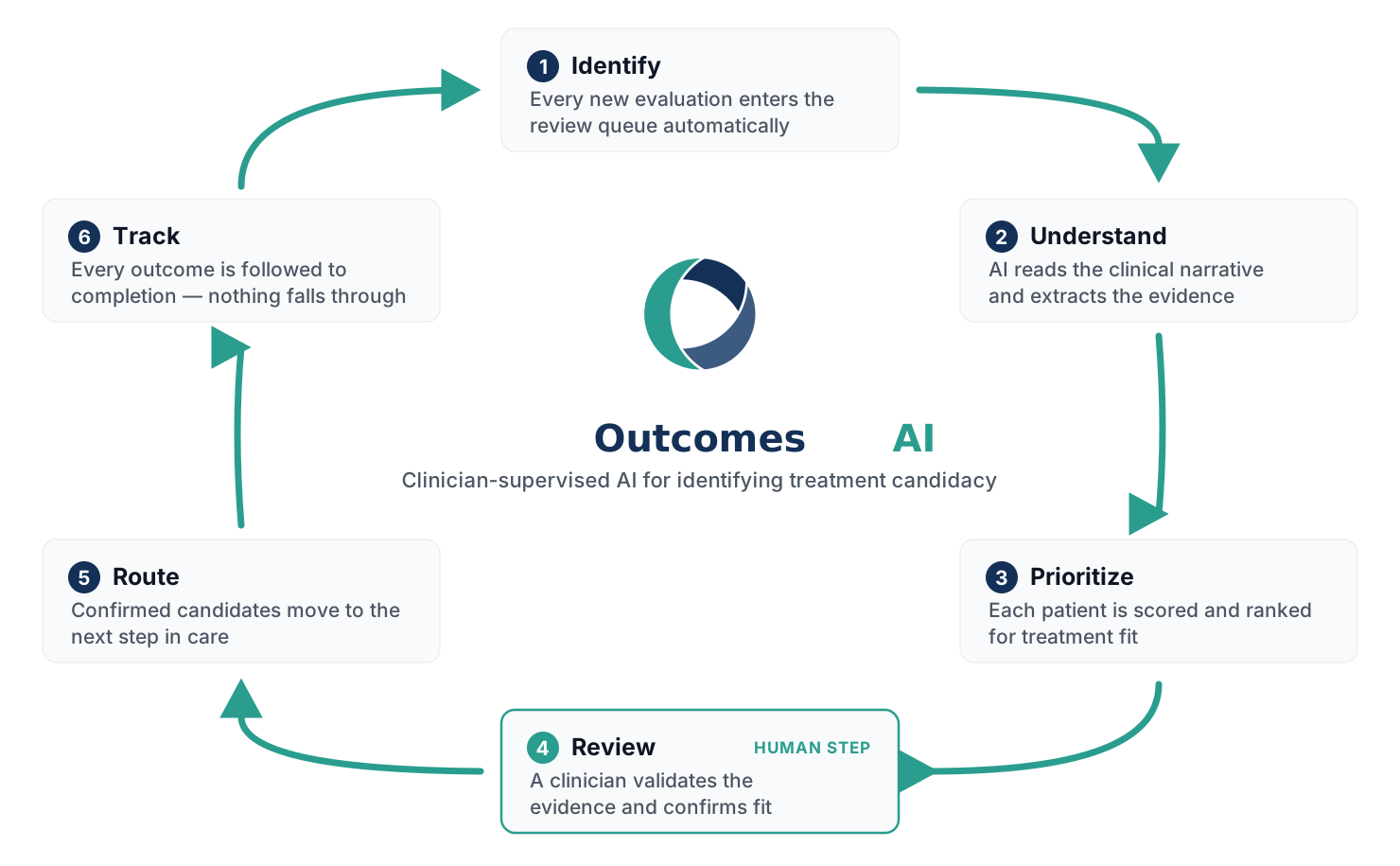
OutcomesAI uses AI for the task it performs well—finding and structuring evidence in narrative documentation—then applies explicit rules and safety checks before a clinician reviews the result.
Input
Clinical Documentation
AI
AI Evidence Extraction
Structure
Structured Clinical Findings
Logic
Deterministic Rules Engine
Controls
Safety Checks
Oversight
Clinician Review
Output
Workflow Action
AI identifies evidence.
The model extracts relevant facts and connects findings to the source documentation.
Rules apply defined logic.
Versioned, deterministic criteria evaluate structured findings and apply safety controls.
Clinicians make decisions.
Care teams verify the evidence, consider the full record, and decide whether and how to act.
3 · Clinical Transformation
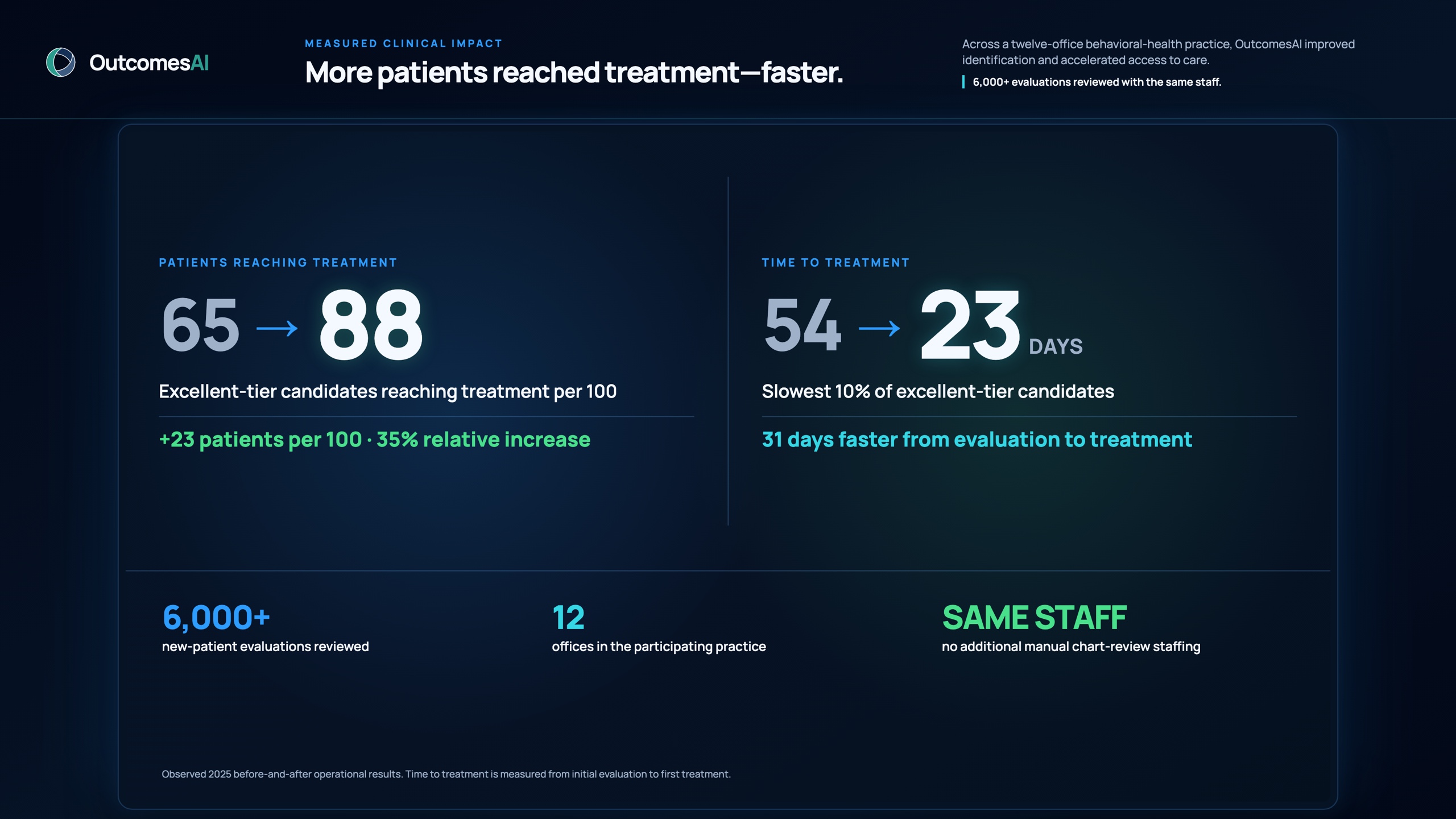
OutcomesAI is designed to improve how healthcare teams identify and review potential treatment opportunities. It brings evidence from clinical documentation into a structured workflow that supports prioritization while preserving clinical judgment.
Healthcare problem
Relevant clinical facts can remain buried in narrative notes when no team can consistently review every in-scope record.
Workflow transformation
OutcomesAI organizes findings into a governed workflow while preserving their connection to the source record.
Clinician impact
Source-linked findings help clinical teams understand why an opportunity was surfaced and decide what deserves review.
 Open full resolution
4 · Methodology & Governance
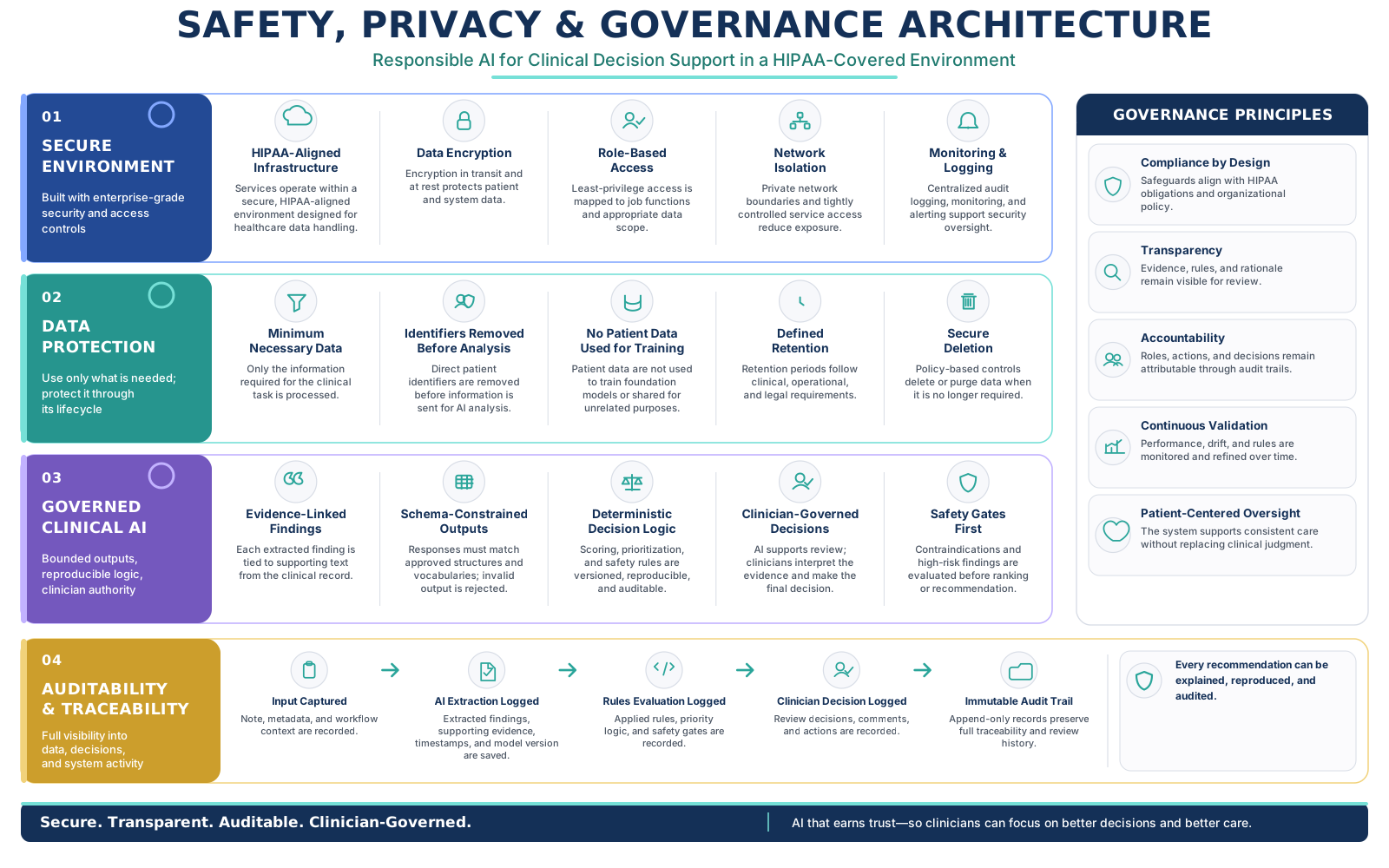
AI extraction is bounded to identifying documented evidence. Deterministic rules evaluate defined clinical and safety criteria separately from the AI model, and clinicians retain authority over every decision.
5 · Responsible AI
OutcomesAI supports clinicians by organizing evidence and prioritizing review. It does not diagnose, prescribe, authorize outreach, or make treatment decisions autonomously.
Human clinical oversight
Clinicians verify context and retain authority over care decisions.
Evidence traceability
Structured findings remain connected to the supporting source documentation.
Deterministic safety controls
Defined rules and safety checks are separated from AI evidence extraction.
No autonomous treatment decisions
The system surfaces opportunities for review; clinicians decide what happens next.
Auditability
Evidence, rules, safety checks, and review status create an inspectable decision-support record.
6 · Initial Clinical Application
TMS offered an evidence-rich pathway with explicit clinical criteria and a clinician-reviewed workflow. The same Clinical Opportunity Intelligence architecture can support additional pathways using pathway-specific evidence, rules, safety controls, and clinical governance.
Evidence Chain